


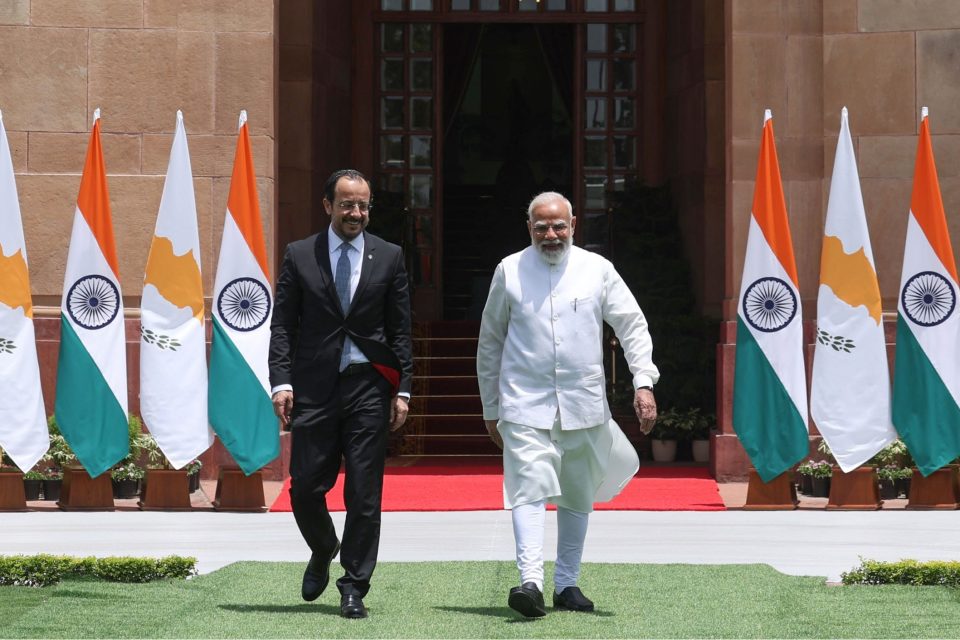
Cyprus President’s Visit to India (May 2026): Advancing Strategic and Business Cooperation
In May 2026, the President of the Republic of Cyprus, Nikos Christodoulides, undertook a landmark four-day state visit to India (20–23 May 2026) at the invitation of Prime Minister Narendra Modi. The visit marked a significant milestone in bilateral relations, with a strong emphasis on business development, investment flows, and strategic collaboration between the two countries.
Strengthening Economic and Business Links
A central pillar of the visit was the promotion of economic cooperation and bilateral trade. The Cypriot President was accompanied by a high-level delegation of ministers and business leaders, highlighting the commercial focus of the mission.
The visit began in Mumbai, India’s financial hub, where the President participated in the Cyprus–India Business Forum. The forum brought together leading corporates and institutional investors, aiming to expand trade, attract investment, and foster partnerships in sectors such as financial services, shipping, energy, and technology.
Cyprus positioned itself as a gateway to the European Union, offering Indian companies access to EU markets, while encouraging Indian investors to use Cyprus as a base for international expansion into Europe, the Middle East, and beyond.
Elevation to a Strategic Partnership
A key outcome of the visit was the formal elevation of the India–Cyprus Comprehensive Partnership to a “Strategic Partnership.” This reflects the deepening engagement across multiple sectors and signals a shift toward a more implementation-driven and results-oriented collaboration framework. The elevation built directly on Prime Minister Modi’s own visit to Cyprus in June 2025, which had first established the Comprehensive Partnership and laid the groundwork for closer ties.
The two countries signed six government-to-government MoUs and agreements and advanced cooperation across a range of areas. The signed MoUs covered:
- Counter-terrorism cooperation (a joint working group)
- Diplomatic training and institutional cooperation
- Higher education and research
- Cultural cooperation
- Innovation and technology
Additionally, a Defence Cooperation Roadmap for 2026–2031 was agreed, alongside new mechanisms such as a Cyber Security Dialogue and a Consular Dialogue, strengthening institutional ties. Separately, a number of business-to-business MoUs were signed on the sidelines of the Business Forum in Mumbai, including between the Confederation of Indian Industry and the Cyprus Chamber of Commerce and Industry.
Focus on Innovation, Technology, and Finance
Beyond traditional sectors, the discussions placed strong emphasis on emerging industries, including:
- Artificial intelligence (AI)
- FinTech and digital payments
- Innovation and research collaboration
- Technology partnerships
One notable development was the announcement that India’s Unified Payments Interface (UPI) is expected to become operational in Cyprus in 2027, enhancing cross-border financial connectivity. The two sides also welcomed work on a framework for interoperability between UPI and the European Central Bank’s TIPS instant-payment system, aimed at facilitating seamless cross-border transactions.
Both governments also encouraged business-to-business partnerships and deeper integration between their financial and services sectors, reinforcing Cyprus’ role as a financial and investment hub linking India with Europe.
Expanding Trade and Investment Flows
The visit highlighted the already significant economic relationship between the two countries. Cyprus is among the top foreign investors in India, with cumulative investments of approximately $16 billion since 2000, spanning sectors such as services, construction, shipping, and pharmaceuticals. According to figures cited during the visit, this ranks Cyprus as the ninth-largest source of FDI into India and the second-largest within the EU after the Netherlands.
Both sides expressed ambition to double investment flows in the coming years, leveraging new opportunities arising from the evolving India–EU economic relationship and prospective trade agreements.
In parallel, plans were announced to establish a Cyprus Trade Center in Mumbai, further institutionalising commercial engagement and facilitating business access between the two markets.
Broader Strategic and Geopolitical Significance
The visit also carried wider strategic implications. Taking place during Cyprus’ Presidency of the Council of the European Union, it reinforced Cyprus’ role as a bridge between India and Europe.
Both leaders reiterated support for initiatives such as the India-Middle East-Europe Economic Corridor (IMEC) and enhanced cooperation in maritime connectivity, logistics, and infrastructure.
President Christodoulides’ visit to India in May 2026 marked a significant turning point in bilateral relations, with a clear shift toward deeper economic integration and business collaboration. By elevating ties to a Strategic Partnership, launching new agreements, and promoting investment and innovation, both countries have laid the foundation for long-term cooperation across trade, technology, and finance.
The visit underscored Cyprus’ growing role as a strategic European partner for India, while opening new opportunities for businesses in both countries to expand into each other’s markets and beyond.


